
AI SEO for Lawyers
The 2026 Ultimate Guide

Written by: Rahul Mulchandani
Founder, Digital Marketing Strategist and
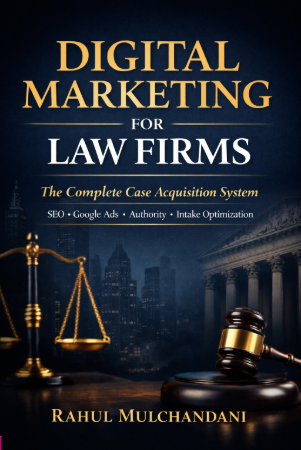
Author of "Digital Marketing For Lawyers" Book
Written by: Rahul Mulchandani
Founder, Digital Marketing Strategist and Author of "Digital Marketing For Lawyers" Book
Table of Contents
AI SEO for lawyers integrates classic search engine optimization with strategies designed to make your firm visible and frequently cited in generative AI experiences like Google AI Overviews, Gemini, ChatGPT, Perplexity, and Claude. In 2026, AI Overviews now trigger on roughly 60-82% of legal-related queries, with studies showing they reduce click-through rates for the top organic position by 58% on average — and up to 61% in some analyses.
Done correctly, AI SEO for lawyers ensures your firm becomes one of the 3-5 authoritative sources AI systems pull from when answering high-stakes questions about car accidents, divorce proceedings, or estate planning. It amplifies E-E-A-T signals that both Google’s Helpful Content system and large language models prioritize. Poor execution leaves your content summarized without attribution, eroding visibility and making your firm invisible in the zero-click reality that now dominates legal discovery. This guide delivers the precise framework senior legal marketing consultants apply with managing partners: the distinctions between SEO/AEO/GEO, technical website upgrades, content restructuring, entity optimization, ethics compliance, and measurable execution steps that produce real consultation growth.
What Is AI SEO for Lawyers
AI SEO for lawyers is the practice of optimizing your online presence so that both traditional Google rankings and generative AI systems surface your firm’s expertise. It extends beyond keyword targeting to Generative Engine Optimization (GEO) and Answer Engine Optimization (AEO)—structuring content, schema, and authority signals so AI models extract, summarize, and cite your information accurately.

Traditional SEO focused on blue links. AI SEO focuses on becoming a citable source when someone asks “What should I do after a car accident in Chicago?” or “How does child custody work in California?” AI engines synthesize answers from multiple sources and often include a carousel of citations. Your goal shifts from driving every click to earning inclusion in those summaries while still capturing traffic from users who want deeper guidance.
In practice, this means creating content that AI can easily parse: clear direct answers, structured data, attorney-authored depth, and verifiable credentials. Firms that treat AI SEO as an add-on to old tactics fall behind. Those that redesign around it gain compounded visibility across Google, ChatGPT, Perplexity, and Gemini.
Why AI SEO Matters for Law Firms in 2026
Potential clients increasingly start journeys in AI interfaces rather than traditional search. AI Overviews now dominate many informational and commercial legal queries, sometimes reducing organic CTRs by 40-60% for non-cited pages. Yet firms cited in AI responses gain brand exposure and trust signals that convert later in the funnel.
Legal marketing benchmarks show SEO still delivers the highest long-term ROI—approximately 526% over three years for many firms—because it compounds. AI SEO protects and amplifies that investment. When Google’s AI Overviews pull from your practice area pages, your firm appears as an authoritative voice even in zero-click scenarios. For high-intent queries, users who bypass the summary often click through to the most cited sources.
For consumer practices like personal injury or family law, AI SEO influences local discovery and Map Pack visibility. For business-oriented practices, it strengthens referral networks when AI recommends your firm in professional contexts. Ignoring it risks your content being summarized without attribution, eroding topical authority, and making your firm invisible to the next generation of legal search.
SEO vs AEO vs GEO: Key Differences and Why All Three Matter
Understanding the distinctions prevents wasted effort. Here is how they compare in a law firm context:
| Factor | Traditional SEO | AEO (Answer Engine Optimization) | GEO (Generative Engine Optimization) |
|---|---|---|---|
| Primary Goal | Rank in blue links | Appear in featured snippets & direct answers | Get cited in AI-generated responses |
| Success Metric | Rankings, organic traffic, CTR | Snippet inclusion, voice search | Citation frequency, brand mentions |
| Content Focus | Keyword-rich, comprehensive pages | Clear Q&A format, structured data | Authoritative, entity-rich, citation-ready |
| Law Firm Example | Ranking #1 for “Chicago car accident lawyer” | Featured snippet for “steps after accident” | Cited by ChatGPT or Gemini as trusted source |
Traditional SEO builds foundational authority and discoverability. AEO ensures your content delivers immediate, parseable answers. GEO translates that authority into AI recommendations. Strong traditional SEO increases the odds AI systems will consider and cite your content. The highest-performing firms run all three in parallel rather than treating them as separate or sequential strategies.
Get More Clients for Your Law Firm
Stop losing potential cases to competitors. Let’s build a strategy that brings you consistent, high-quality leads.
How AI Search Engines Work and What They Prioritize
AI engines like Google’s AI Overviews (powered by Gemini), Perplexity, and ChatGPT use large language models trained on vast web data. They prioritize sources with strong E-E-A-T—Experience, Expertise, Authoritativeness, and Trustworthiness—plus clear structure that allows easy information extraction.
Key prioritization factors include:
- Direct, concise answers near the top of pages, often in FAQ or dedicated sections.
- Structured data (schema markup) that explicitly defines your LegalService, Attorney, and FAQ entities.
- Author credentials with bios, bar admissions, case results, and publications.
- Original, human-verified content over generic or purely AI-generated text.
- Entity consistency across your site, Google Business Profile, directories, and social profiles.
AI models favor government (.gov) and high-authority sources in some summaries, but they also cite practical, client-focused law firm content when it demonstrates unique experience. A 2025-2026 analysis showed Wikipedia, YouTube, and Reddit still appear frequently, creating an opening for firms that produce clearer, more actionable guidance than these general sources.
In a realistic scenario, a Chicago personal injury firm optimized its “What to Do After a Car Accident” page with attorney-specific examples, step-by-step schema, and verified case statistics. It began appearing in AI Overviews and Perplexity responses, driving both direct traffic and branded searches.
Core Technical Changes Your Law Firm Website Needs
Your website must become AI-friendly infrastructure. Start with Core Web Vitals compliance—AI crawlers penalize slow or unstable pages just as Google does.
Implement comprehensive schema markup: LegalService for practice areas, Attorney for individual lawyers (including knowsAbout, hasCredential, award), FAQPage for common questions, and Organization for firm details. Use JSON-LD and test with Google’s Rich Results Test plus schema validators that simulate AI extraction.
Restructure practice area and blog pages for scannability. Place the most direct answer in the first 100-150 words, followed by detailed explanations, bullet points, tables, and numbered steps. AI models extract from these formats more reliably than dense paragraphs.
Optimize for entity-based understanding rather than keyword density. Create semantic silos around core topics—e.g., one hub page for “Illinois Personal Injury Claims” linking to sub-pages on specific injuries, statutes, and processes. Use internal linking that reinforces relationships between entities.
Mobile-first design remains non-negotiable; most AI queries originate on mobile. Ensure fast loading, accessible contrast, and clear navigation. Firms that rebuilt practice pages with bolded answers, comparison tables (e.g., “Contingency Fee vs. Hourly in PI Cases”), and attorney photos with alt text saw higher citation rates in tests.
Building Content That AI Engines Cite
AI-citable content answers questions completely while demonstrating unique attorney experience. Shift from thin 800-word posts to comprehensive guides (2,000–4,000 words) that include real (redacted) case insights, data points, and step-by-step client journeys.
Use the inverted pyramid: answer the question immediately, then layer supporting evidence. Include original research, such as local court filing statistics or firm-specific settlement ranges (ethically presented). Create comparison tables AI loves to scrape—e.g., “Divorce Processes: Mediation vs. Litigation in [State]”.
Repurpose attorney knowledge: record consultations (with consent), transcribe, and turn into structured FAQs or carousels. Human review and editing are mandatory—AI-generated first drafts can hallucinate citations or oversimplify nuances, violating bar rules on competence and truthfulness.
Best practice: assign each practice area a content pillar owned by a specific attorney. Publish updates when laws change to signal freshness. Firms using tools like Legalwrite for structured first drafts (then heavy human editing) report faster production while maintaining compliance and depth.
Strengthening E-E-A-T and Entity Signals for AI Visibility
Google’s Search Quality Evaluator Guidelines and Helpful Content system emphasize E-E-A-T, which AI engines amplify. Demonstrate experience through detailed attorney bios listing years in practice, notable cases (without guarantees), publications, and speaking engagements.
Build entity authority by claiming and optimizing profiles on Justia, Avvo, Martindale-Hubbell, Super Lawyers, and LinkedIn. Maintain perfect NAP (Name, Address, Phone) consistency across directories—AI models flag inconsistencies as low trust.
Encourage and respond to reviews on Google Business Profile and legal directories. Consistent positive signals across platforms reinforce trustworthiness.
Citation building for GEO involves getting mentioned in reputable legal publications, bar association resources, and industry reports. Original research or data-backed guides increase the likelihood of being cited as a primary source.
In practice, a mid-sized family law firm added “About the Attorney” schema with alumniOf, award, and knowsAbout properties plus published client journey maps. Within months, it appeared in more Perplexity and Gemini responses for custody-related queries.
Step-by-Step Implementation Plan for AI SEO
- Audit current visibility. Query your top practice-area keywords in Google AI Overviews, ChatGPT, Perplexity, and Gemini. Note which sources get cited and where your firm is missing.
- Technical foundation. Implement or update schema markup using JSON-LD for all practice pages and attorney profiles. Test with Google’s tools and third-party AI simulators.
- Content audit and rebuild. Review top 10-20 pages. Rewrite openings with direct answers. Add structured sections, tables, and attorney authorship. Verify all legal information with current statutes and case law.
- Entity and directory cleanup. Ensure 100% NAP consistency. Claim unclaimed profiles and update with full credentials.
- Create AI-optimized assets. Build or refresh FAQ sections, how-to guides, and comparison content. Include original elements like local statistics or firm methodologies.
- Internal linking and silo structure. Map and implement topic clusters that reinforce semantic relationships.
- Monitoring setup. Track traditional rankings plus AI mentions using tools that monitor LLM outputs across platforms.
- Compliance layer. Establish a review process where every published piece receives attorney sign-off for accuracy and advertising compliance under ABA Model Rule 7.1.
Execute in 90-day sprints, starting with your highest-volume practice area.
Tracking Performance and ROI in an AI-Driven Landscape
Traditional metrics still matter—organic traffic, rankings, and conversions—but add AI-specific tracking. Monitor citation frequency in major AI tools (some specialized platforms like Gumshoe AI or Evertune track “share of LLM” across thousands of prompts).
Use Google Analytics 4 with enhanced event tracking for assisted conversions from AI-driven branded searches. Track form submissions and calls from pages known to appear in AI summaries.
Key benchmarks: Aim for inclusion in AI Overviews for 30-50% of core queries within 6-12 months of optimization. Legal SEO conversion rates can reach 7%+ for well-optimized pages. Expect initial ROI timelines of 9-14 months as authority builds, with compounding gains thereafter.
Review monthly: which pages earn citations, what content types perform best, and how AI visibility correlates with lead quality.
Common Mistakes Law Firms Make with AI SEO
Many firms treat AI SEO as “add schema and hope.” They publish AI-generated content without verification, risking hallucinations and bar complaints. Others focus only on traditional keywords while ignoring structured data and direct-answer formatting.
Some spread efforts too thin across every practice area instead of dominating one pillar first. Neglecting directory consistency or attorney bios weakens entity signals that AI heavily weights.
The fix is systematic: prioritize depth over volume, enforce human oversight on all content, and measure citations rather than just rankings. Firms that audited and rebuilt just their top three practice pages before expanding saw faster wins than those attempting site-wide overhauls simultaneously.
Emerging Trends and Tools for 2026 and Beyond
GEO and AEO continue evolving alongside Google’s AI investments. Expect tighter integration between traditional rankings and generative citations. Voice and conversational search will reward natural-language, question-first content even more.
Tools for monitoring AI visibility (prompt-tracking platforms) and structured content generators (with heavy human editing) are becoming standard. Legal-specific AI for research and drafting can accelerate content creation when used ethically.
Zero-click and multi-platform discovery mean your firm must maintain presence across Google, directories, and AI training data sources. Firms investing in original data or unique client resources gain defensible moats.
Next steps: This week, run AI visibility audits for your top three practice-area keywords across Google AI Overviews, Perplexity, and ChatGPT. Identify gaps in direct answers and schema on your highest-traffic pages. Schedule attorney time to review and expand one key guide with structured sections and credentials. Track baseline citations now so you can measure progress in 30-60 days. Firms that start with focused execution on one pillar achieve measurable citation gains and lead quality improvements faster than those attempting everything at once.
Frequently Asked Questions
What is AI SEO for lawyers and how does it differ from traditional SEO?
AI SEO for lawyers optimizes your digital presence for both Google’s traditional results and generative AI systems like AI Overviews, Gemini, ChatGPT, Perplexity, and Claude. Traditional SEO targets rankings in blue links through keywords, backlinks, and technical factors. AI SEO emphasizes becoming a citable source that AI models extract from and attribute when synthesizing answers. This requires direct answers at the top of pages, robust schema markup (LegalService, Attorney, FAQPage), strong E-E-A-T signals via attorney credentials and original insights, and content structured for easy parsing—bullet points, tables, and numbered steps. In 2026, with AI Overviews appearing in up to 60% of searches, firms that only do traditional SEO risk lower visibility and fewer citations. The practical difference appears in results: traditional SEO might rank your page #1, but AI SEO gets your firm named in the summary carousel that users see first. Many firms now combine both for compounded authority and leads.
How do Google AI Overviews affect law firm SEO and lead generation?
Google AI Overviews summarize answers at the top of results, often pulling from multiple sources and citing them. For law firms, this can reduce traditional CTRs—sometimes by 40-60% on informational queries—because users get quick answers without clicking. However, being cited provides brand exposure and trust that influences later decisions. High-intent transactional queries still drive clicks to detailed pages. To benefit, structure content with immediate answers, FAQ schema, comparison tables, and verifiable expertise. Firms cited regularly see increased branded searches and higher-quality leads from users seeking deeper guidance. Track both organic traffic and AI citation frequency. In practice, personal injury firms optimizing “after accident” pages with step-by-step schema and local data maintained or grew consultations despite broader CTR shifts. AI Overviews reward depth and authority rather than thin content, aligning with Google’s Helpful Content guidelines.
What is Generative Engine Optimization (GEO) for law firms?
Generative Engine Optimization (GEO) structures content and authority signals so AI models like ChatGPT, Perplexity, and Gemini cite your firm when generating responses to legal questions. It builds on traditional SEO but prioritizes citation-worthiness: clear entity definitions via schema, original attorney insights, data-backed claims, and consistent presence across high-trust directories. Key tactics include semantic topic clusters, FAQ formats with direct answers, and building “share of LLM” through mentions in reputable sources. Unlike classic SEO focused on rankings, GEO aims for inclusion in synthesized answers. A family law firm that added detailed attorney bios with knowsAbout schema and published state-specific process guides began appearing in more AI responses within months. GEO works best when layered on strong technical SEO and E-E-A-T. In 2026, firms treating GEO as separate from SEO underperform; the most successful integrate both for visibility across all search surfaces.
Which schema markup is most important for AI SEO in law firms?
Prioritize LegalService schema for practice areas (including areaServed, serviceType, and hasOfferCatalog), Attorney schema for individual lawyers (with knowsAbout, hasCredential, award, alumniOf), FAQPage for question-answer pairs, and Organization schema for firm details. These help AI engines understand exactly what your firm does, who your attorneys are, and which questions your content answers. Implement as JSON-LD and validate regularly. Pages with comprehensive Attorney and FAQ schema are extracted more reliably by AI crawlers. For example, a criminal defense firm that marked up attorney profiles with specific practice expertise saw higher inclusion rates in Perplexity answers about local charges. Combine with on-page structures like bolded answers and tables for maximum effect. Schema alone won’t fix weak content, but it significantly boosts citability when paired with high-quality, human-reviewed material. Test implementations with Google’s Rich Results Test and tools that simulate AI parsing.
How should lawyers use AI tools ethically when creating SEO content?
Lawyers remain fully responsible for all published content under ABA Model Rules, including Rule 7.1 (truthful advertising) and competence obligations. Use AI only for first drafts or research assistance—never as final output without thorough human review and verification of every legal statement, citation, and claim. Establish a written firm policy requiring attorney sign-off on accuracy, avoidance of guarantees, and proper disclaimers. Never input confidential client data into public AI models. For marketing content, ensure it does not mislead and includes required responsible attorney information where applicable. Periodic audits of AI-assisted pages prevent issues. Firms using specialized legal writing tools for structured drafts (followed by heavy editing) maintain compliance while increasing output. Ethical use accelerates production but never replaces professional judgment. State bars continue issuing guidance; review yours annually and default to the strictest interpretation to protect your license.
What content types work best for AI SEO for lawyers?
AI engines favor content with clear structure and demonstrable expertise: comprehensive how-to guides with numbered steps, FAQ sections with direct concise answers, comparison tables (e.g., “Contingency vs. Hourly Fees”), and attorney-authored insights with real-world (ethically presented) examples. Place the core answer in the first paragraph, then expand with supporting details, data, and credentials. Original elements—local statistics, unique methodologies, or redacted case journeys—make content more citable than generic explanations. Evergreen pillar pages on core practice topics outperform scattered blog posts. Update content when laws change to signal freshness. A plaintiff-side PI firm that rebuilt its accident guide with bolded steps, insurance timelines in tables, and attorney bios saw improved AI citations and lead quality. Focus on depth and scannability rather than length alone. Human oversight ensures nuance and compliance that pure AI content lacks.
How long does it take to see results from AI SEO for law firms?
Expect 6-12 months for meaningful citation gains and traffic stabilization, with some early wins in 3-6 months on optimized pages. Authority building is compounding—initial technical and schema work unlocks faster content impact. Firms focusing on one high-volume practice area first often see citations within 90 days on rebuilt pages, followed by broader lift. ROI timelines align with traditional SEO (break-even around 9-14 months, strong returns by year three). Track both traditional metrics and AI visibility (mentions across tools) from day one. Consistent execution on content updates and entity signals accelerates results. Firms that audited visibility first and prioritized schema + direct-answer restructuring reported faster progress than those attempting full-site changes simultaneously. Patience and measurement are essential; AI engines reward sustained authority over quick fixes.
Should law firms focus more on GEO or traditional SEO in 2026?
Focus on both—they reinforce each other. Strong traditional SEO (technical health, topical authority, backlinks) provides the foundation AI engines trust and cite. GEO tactics (structured data, direct answers, entity optimization) ensure that authority translates into AI visibility. Firms ignoring GEO risk reduced clicks even when ranking well; those ignoring traditional SEO lack the depth AI needs for credible citations. In practice, integrate them: optimize pages for Google rankings while adding AI-friendly structures. Legal benchmarks show SEO still drives the majority of long-term ROI, but AI citations enhance brand trust and assisted conversions. Allocate resources to both in parallel—technical audits and schema first, then content restructuring. The highest-performing firms treat AI SEO as an evolution of traditional strategies rather than a replacement.
What tools help monitor AI SEO performance for lawyers?
Use Google Search Console and Analytics 4 for traditional metrics and assisted conversions. For AI-specific tracking, platforms that run thousands of test prompts across ChatGPT, Gemini, Perplexity, and Claude (such as Gumshoe AI or similar) show your “share of LLM” and citation sources. Traditional SEO tools like Semrush or Ahrefs help track rankings and content gaps, while schema testers validate markup. Directory monitoring tools ensure NAP consistency. Combine these with manual periodic searches in major AI interfaces for your key queries. Set up alerts for ranking or visibility drops. Firms using prompt-tracking tools identify which topics trigger citations and which competitors dominate certain questions, allowing targeted content updates. Start with free/manual audits, then layer paid monitoring as volume grows. Regular reviews every 30 days keep efforts aligned with actual performance.
How can small or solo law firms implement AI SEO effectively?
Small firms and solos can compete effectively by focusing on depth in one or two practice areas rather than breadth. Begin with a technical audit and schema implementation on core pages—free or low-cost tools suffice initially. Leverage your personal expertise for authentic, attorney-authored content that larger firms often lack. Optimize Google Business Profile alongside website changes for local AI visibility. Create 2-3 high-quality pillar guides with FAQs, tables, and direct answers instead of frequent shallow posts. Use AI assistance for drafting only, with full personal review. Maintain directory profiles and encourage reviews. Many solos see strong results because authenticity and niche focus signal strong E-E-A-T. Batch content creation around court schedules and use scheduling tools. Track progress manually at first. Consistency in one area builds authority faster than diluted efforts across many. The barrier is discipline, not firm size.
Is AI-generated content safe for law firm websites?
No—publishing unedited AI-generated content carries significant risks. AI can hallucinate statutes, cases, or outcomes, violating competence and advertising rules (ABA Model Rule 7.1 and state equivalents). Lawyers are personally responsible for all content. Use AI only for outlines, research assistance, or initial drafts, followed by thorough attorney verification, editing, and sign-off. Implement a firm policy documenting the review process. Public AI tools may train on inputs, raising confidentiality concerns—avoid client-specific data. For marketing content, ensure no misleading claims or guarantees. Firms that combine AI speed with rigorous human oversight maintain compliance and quality. Pure AI content often lacks the nuanced judgment clients expect and can damage E-E-A-T if inaccuracies surface. Treat AI as a productivity tool, never a substitute for professional expertise.
🚀 Get Free Consultation
Our Latest Posts
-
 How We Generate Signed Cases for Lawyers: 7 Proven Strategies That Deliver Real Results
 -
 Case Study: Multi-City Personal Injury SEO Success – New Mexico
 -
 Case Study: Personal Injury Lawyer in Texas
 -
 Lawyer SEO: The Complete Guide to Optimizing Law Firm Websites for Clients and Rankings
 -
 Why Lawyer Switch to Us
Updated on
Get In Touch with Us!
other way to contact us
Office Email
rahul@webkeydigital.com
Office Phone
+1 503-303-8639
Office Location
8 The Green STE A, Dover, Kent , Delaware 19901
