
SEO for Lawyers
2026 Law Firm SEO Guide

Written by: Rahul Mulchandani
Founder, Digital Marketing Strategist and
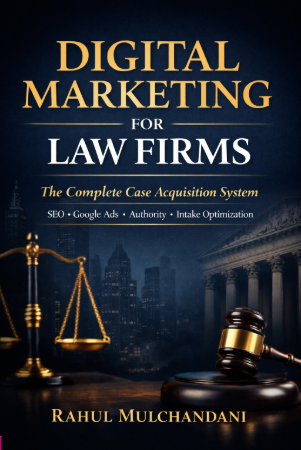
Author of "Digital Marketing For Lawyers" Book
Written by: Rahul Mulchandani
Founder, Digital Marketing Strategist and Author of "Digital Marketing For Lawyers" Book
Table of Contents
SEO for lawyers is the disciplined process of improving your law firm’s visibility in Google search results so that prospective clients find you when they need legal help. In 2026, it is no longer optional. With 58% of searches ending in zero clicks and AI Overviews dominating high-intent legal queries, law firms that treat SEO as a core business function capture the majority of organic leads while competitors relying on outdated tactics or paid ads alone fall behind.
Google’s 2025 core updates—particularly the December 2025 rollout—targeted low-value, AI-generated content in YMYL categories like legal services. Firms that published thin or repetitive pages without demonstrable real-world expertise saw traffic drops of 40-60%. The winners demonstrated genuine Experience, Expertise, Authoritativeness, and Trustworthiness (E-E-A-T) through attorney credentials, original case insights, and consistent local signals.
This guide gives law firm owners and marketing managers the exact framework that works right now: keyword strategies mapped to client intent, technical requirements that satisfy Core Web Vitals, content that ranks in both traditional results and AI summaries, local dominance tactics, and ROI tracking that ties rankings to signed cases. Follow it and you will outperform generic “SEO for lawyers” advice that still circulates from 2023-2024 playbooks.
What Is SEO for Lawyers and Why It Matters in 2026
SEO for lawyers combines technical optimization, authoritative content, and local signals to rank your practice-area pages when potential clients search phrases like “car accident lawyer near me” or “estate planning attorney [city]”. Unlike generic SEO, it must comply with state bar advertising rules—no guarantees, no misleading claims—and prioritize trust because legal decisions involve money, freedom, or family futures.

In 2026 law firms allocate 45% of marketing budgets to SEO because it delivers the highest long-term ROI compared with PPC. Organic search still drives the majority of website traffic and two-thirds of call conversions for most practices.
Yet the game changed: AI Overviews now appear for many commercial legal queries, slashing traditional click-through rates. Firms visible in those summaries capture attention even when users never reach page one.
The practical payoff is clear. A mid-sized personal injury firm in a competitive market that implements the framework in this guide routinely sees 3-5x more qualified leads within 12 months than firms that only refresh meta tags or buy directory links. SEO for lawyers is now entity-based visibility: Google and AI systems recognize your firm as the authoritative source across search, Knowledge Panels, and generative answers.
How Google’s 2025-2026 Updates Reshaped Legal SEO
Google’s December 2025 core update and February 2026 follow-up hit YMYL content hardest. The algorithm now penalizes “experience dilution”—pages that cover topics competently but lack first-hand insight from licensed attorneys. Law firm sites relying on AI writers without human oversight lost up to 60% of organic impressions.
The Helpful Content system and updated Search Quality Evaluator Guidelines reward pages created by people with real experience. For lawyers this means every practice-area page must demonstrate:
- Who wrote it (attorney bio with bar number and years of practice)
- Why they are qualified (specific case results, anonymized)
- How the advice applies in the reader’s jurisdiction
AI Overviews expanded aggressively into legal searches in late 2025. Queries that once sent traffic to page one now resolve in the summary box. To appear there your content must be structured, cite primary sources where appropriate, and answer the exact question in the first 50-70 words. Traditional ranking factors (backlinks, domain authority) still matter for the “10 blue links,” but entity signals and direct-answer formatting now decide visibility in generative results.
Firms that audited and refreshed content post-December 2025 recovered fastest. The lesson: stop producing volume. Start producing pages that only your firm could write because of your actual courtroom or boardroom experience.
Establishing E-E-A-T Signals That Google Rewards for Law Firms
Google’s Search Quality Evaluator Guidelines explicitly flag legal content as high-stakes YMYL. Demonstrating E-E-A-T is therefore non-negotiable.
Experience — Publish attorney bios that list bar admissions, jurisdictions, years in practice, and notable verdicts or settlements (anonymized where required). Add “Written by” authorship schema and link to LinkedIn profiles showing real professional history.
Expertise — Include original analysis. A family law page should explain recent changes to child support guidelines in your state with specific examples from your cases, not generic templates. Cite statutes, court rules, and local precedents.
Authoritativeness — Earn mentions from bar associations, legal directories (Martindale-Hubbell, Avvo, Justia), and local news. Co-author amicus briefs or speak at CLE events—these create natural backlinks and entity signals.
Trustworthiness — Display state bar badges, client review schema, clear disclaimers, and transparent fee structures. Respond to every Google review within 24-48 hours; Google tracks response velocity as a trust factor.
A practical audit: run your site through Google’s own guidelines checklist. If a rater cannot quickly confirm the author is a licensed attorney with relevant experience, your E-E-A-T score is too low for competitive practice areas.
Get More Clients for Your Law Firm
Stop losing potential cases to competitors. Let’s build a strategy that brings you consistent, high-quality leads.
Keyword Research and Intent Mapping for Legal Practice Areas
Keyword research for lawyers starts with client intent, not search volume alone. Use Google Keyword Planner, Semrush Keyword Magic Tool (filter for “Legal” intent), and Google Search Console to identify terms your site already ranks for.
Map every keyword to the four intent stages:
- Informational (“what is the statute of limitations for car accidents in [state]”)
- Navigational (“[firm name] reviews”)
- Transactional (“hire divorce lawyer [city]”)
- Local (“DUI attorney near me”)
Prioritize transactional and local modifiers for money pages. For multi-practice firms create practice-area silos: one cluster for personal injury, another for estate planning, each with its own pillar page and 8-12 supporting cluster articles.
Gap most guides miss: analyze “People Also Ask” and AI Overview triggers directly in Google. Tools like AlsoAsked or Semrush’s Questions report show exact phrasing. Create dedicated FAQ sections that answer those verbatim. Track performance in Google Search Console using the “Performance” report filtered by query and page. Good benchmarks: top 3 positions for primary keywords should deliver 15-25% lead-to-consultation rates when paired with strong conversion elements.
On-Page and Technical SEO Essentials for Attorney Websites
On-page optimization for law firms demands precision. Title tags should read: “[Primary Service] Lawyer in [City] | [Firm Name]”. Keep under 60 characters. Meta descriptions must include the city, service, and a clear benefit while staying under 160 characters.
Use schema markup aggressively:
- LegalService schema on every practice page (serviceType, areaServed, hasOfferCatalog)
- FAQPage schema for question clusters
- Attorney and Review schema for bios and testimonials
Technical must-haves in 2026:
- Core Web Vitals: LCP < 2.5s, FID < 100ms, CLS < 0.1 (use PageSpeed Insights)
- Mobile-first indexing (test with Google’s Mobile-Friendly Test)
- HTTPS, secure contact forms, and proper robots.txt
- XML sitemap submitted in Google Search Console with lastmod dates updated after every major content change
- Internal linking that flows authority from high-traffic blog posts to service pages
A common technical failure: duplicate content across location pages. Use unique, jurisdiction-specific text on every /location/[city] page rather than templated boilerplate.
Content Strategy That Builds Topical Authority and AI Visibility
Topical authority in legal SEO means owning an entire practice area cluster so Google sees your site as the definitive source. Create one comprehensive pillar page (3,000+ words) per major practice area, then support it with 8-15 cluster articles that interlink tightly.
Write for both humans and AI Overviews. Lead with the direct answer. Use numbered steps, tables comparing options (e.g., Chapter 7 vs Chapter 13 bankruptcy), and bullet-point checklists. Include original graphics, infographics of local court processes, and downloadable guides gated behind contact forms.
Humanize every piece: attorneys should contribute first-person insights (“In my 12 years handling DUI cases in [county], I’ve seen…”). Update content quarterly with new case law or legislative changes—this signals freshness to Google.
For AI visibility add structured data, clear subheadings, and tables. Test by searching your target query and seeing whether your content appears in the Overview; if not, rewrite the first paragraph to match the exact question.
Local SEO Mastery: Google Business Profile and Map Pack Domination
Local search accounts for the majority of legal client acquisition. Optimize your Google Business Profile (GBP) with these non-negotiables:
- Primary category: exact match to your main practice (e.g., “Personal Injury Attorney”)
- All relevant secondary categories and services list
- Weekly posts with before/after anonymized case notes or local legal updates
- 50+ high-quality photos (office, team, courthouse exteriors, client intake areas)
- Q&A section pre-populated with 20+ common client questions and attorney answers
NAP (Name, Address, Phone) consistency across 60+ citation sites remains critical. Use Moz Local or BrightLocal to audit and fix discrepancies.
Review acquisition strategy: automated review requests via text after case milestones (with client consent) plus in-office QR codes. Aim for 4+ new reviews monthly. Respond to every review publicly.
For multi-location firms, use unique landing pages per office with city-specific content, an embedded GBP map, and schema indicating each location.
Off-Page SEO: Quality Links, Entity Authority, and Digital PR
In 2026, backlinks still matter, but only high-authority, relevant ones. Focus on digital PR: secure features in local news, bar association publications, and legal trade outlets. Sponsor community events and request editorial mentions with do-follow links.
Build entity authority through consistent mentions across Wikipedia (if notable), legal directories, and industry databases. Guest post on authoritative sites in your niche (e.g., state bar journals) rather than low-DA blogs.
Track link profile health in Ahrefs or Semrush. Disavow spammy links acquired during earlier “directory blast” eras. A realistic target: 5-10 new relevant links per quarter from domains with DR 60+ in the legal or local news space.
Measuring SEO ROI: From Rankings to Signed Cases
Rankings alone do not pay bills. Set up proper conversion tracking in Google Analytics 4 and Google Tag Manager:
- Event tracking for phone calls (click-to-call on mobile)
- Form submissions tagged with practice area and source
- CallRail or similar for call attribution
Key metrics to watch monthly:
- Organic sessions and users
- Goal completions (consultation requests)
- Lead-to-consultation rate (target 15-25%)
- Cost per lead (SEO benchmark ~$456 vs PPC $784)
Create a custom dashboard in GA4 or Looker Studio that shows revenue attributed to organic traffic. Review quarterly: if top keywords are not converting, revisit landing page UX and trust signals.
Next steps
Audit your current site against the E-E-A-T checklist above. Run a technical crawl with Screaming Frog or Sitebulb. Identify your top three practice areas and build one content cluster each. Claim and fully optimize your GBP today. Schedule a quarterly content refresh calendar. Measure baseline traffic and leads now so you can quantify progress in 90 days. Execute these steps consistently and SEO for lawyers becomes your most predictable, highest-ROI client acquisition channel in 2026 and beyond.
Frequently Asked Questions
What is the most important change in SEO for lawyers in 2026?
The biggest shift is Google’s aggressive preference for human-first, experience-backed content over AI-generated material in YMYL legal topics. The December 2025 core update penalized sites with “experience dilution”—pages that sounded professional but lacked proof of real attorney involvement. To rank you must publish content written or heavily edited by licensed attorneys who reference their own cases (anonymized), cite current local statutes, and include authorship schema. AI Overviews now dominate many queries, so structure every page to answer the searcher’s exact question in the first 50-70 words using clear headings, tables, and lists. Firms that ignored these changes saw 40-60% traffic drops; those that adapted recovered within 8-12 weeks. Combine this with flawless local SEO and you create a defensible moat that generic content farms cannot copy.
Does local SEO still matter for lawyers or has AI search replaced it?
Local SEO remains the highest-converting channel for most law firms in 2026. Even when AI Overviews appear, Google still surfaces Map Pack results for “near me” and city-specific queries. Optimize your Google Business Profile with exact service categories, weekly posts, 50+ geo-tagged photos, and rapid review responses. Maintain NAP consistency across citations. Multi-location firms need unique pages per office with embedded maps and LocalBusiness schema. Data shows firms dominating the Map Pack convert 3-4x better than those relying solely on organic national rankings. AI summaries may reduce some clicks, but they rarely replace the need for a local attorney who appears trustworthy in the three-pack.
How do I demonstrate E-E-A-T on my law firm website?
Google’s evaluators look for clear signals that the content creator has real expertise. Add detailed attorney bios with bar admission numbers, jurisdictions, years of practice, and specific case outcomes (redacted). Use “Written by” authorship with schema markup. Publish original analysis tied to recent legislation or court rulings in your state. Collect and display client reviews with Review schema. Include trust badges from your state bar, Avvo, or Martindale-Hubbell. Respond to every review publicly within 48 hours. Link to your LinkedIn and bar profile. These signals tell Google—and clients—that the advice comes from a qualified, practicing attorney rather than an AI content writer.
What technical SEO mistakes do most law firms still make?
Common errors include slow page speed (LCP above 2.5 seconds), missing or incorrect schema markup, duplicate content on location pages, and failure to submit an updated XML sitemap after content changes. Many sites still lack proper mobile optimization or have intrusive interstitials that hurt Core Web Vitals. Fix these by compressing images, implementing lazy loading, using LegalService and FAQPage schema on every relevant page, and creating unique, jurisdiction-specific copy for each city page. Test everything with Google PageSpeed Insights and Search Console’s Core Web Vitals report. These fixes alone often move a site from page two to page one for competitive terms.
How should I structure content for AI Overviews in legal SEO?
Write the direct answer first, then expand. Use numbered steps for processes (“5 steps after a car accident”), comparison tables (Chapter 7 vs 13), and concise bullet lists. Place the most important information in the first 300 words. Add structured data so Google can parse answers easily. Include original insights only your firm possesses. Test by searching your target query—if your page does not appear in the Overview, rewrite the lead paragraph to match the exact question phrasing. Firms that treat content as AI-answer engines see their material quoted in summaries even when traditional rankings are lower.
What keyword research tools and process work best for lawyers?
Start with Google Keyword Planner for volume and competition, then Semrush or Ahrefs to filter legal-intent keywords and analyze competitors ranking in your city. Export “Questions” reports to capture PAA and AI trigger phrases. Map every term to intent stage and assign to specific practice or location pages. Prioritize transactional local keywords with lower competition but high conversion potential. Revisit the list every 90 days because new legislation or court decisions create fresh opportunities. Track performance weekly in Google Search Console filtered by page and query to see which clusters are gaining traction.
How long does it take to see results from law firm SEO?
Realistic timeline: technical and on-page fixes show movement in 4-8 weeks. Content clusters begin ranking in 3-6 months. Local SEO improvements (GBP optimization and reviews) can deliver Map Pack wins in 30-90 days. Full topical authority and consistent case leads typically require 9-12 months of disciplined execution. Firms that publish 4-6 new high-value pieces per month and maintain local signals see faster ROI. Track progress with organic traffic, goal completions, and revenue attribution rather than rankings alone.
Should solo practitioners or small firms invest in SEO?
Yes. Small firms often achieve the highest ROI because they can be more agile. Focus on one or two practice areas and one primary service area. Create hyper-local content and dominate the Map Pack for your city. A solo estate planning attorney who owns “estate planning lawyer [city]” and surrounding towns can generate 8-12 qualified leads per month with modest ongoing effort. Budget 45% of marketing spend to SEO as industry benchmarks recommend. Outsource technical audits and content writing to specialists who understand legal compliance while you provide the expertise.
What is the role of backlinks in 2026 law firm SEO?
Quality over quantity. One link from a state bar journal or local news outlet carries more weight than 50 directory links. Focus on digital PR that generates natural coverage. Guest contribute to authoritative legal publications. Sponsor community events that result in editorial mentions. Monitor your link profile monthly and disavow anything spammy. Entity authority—consistent mentions across directories, news, and social—now influences rankings as much as raw link count. Aim for steady growth of 5-10 relevant, high-DR links per quarter.
How do I track SEO ROI specifically for legal leads?
Install Google Analytics 4 with enhanced e-commerce or goal tracking for form submissions and phone calls. Use CallRail or similar for accurate call attribution. Tag every conversion with practice area and landing page. Build a Looker Studio dashboard that shows organic sessions, consultation requests, lead-to-case rate, and average case value. Compare SEO cost per lead ($400-500 range for many firms) against PPC. Review quarterly: if a page ranks well but does not convert, fix the intake form, add stronger trust signals, or improve page speed. This data-driven approach proves SEO pays for itself many times over.
Can AI tools help with law firm SEO or should I avoid them?
Use AI as a research and drafting assistant only. Never publish AI-generated content without heavy attorney editing and original insights. Google’s 2025 updates specifically targeted unoriginal AI content in legal niches. Use tools like ChatGPT for outlining or keyword clustering, then have your attorneys rewrite every section with real case examples. Always run final drafts through originality checkers and add authorship. AI can speed up research and first drafts, but the published page must clearly come from human legal expertise.
What is the first thing I should do after reading this guide?
Perform a full technical and E-E-A-T audit of your current website. Check Core Web Vitals, implement missing schema, update every attorney bio with credentials, and claim/optimize your Google Business Profile. Choose your top practice area and build the first content cluster (pillar page + 4-6 supporting articles). Set up proper conversion tracking in GA4. These four actions will give you immediate visibility gains and a clear baseline for measuring future progress.
Our Seo Services
🚀 Get Free Consultation
Our Latest Posts
-
 How We Generate Signed Cases for Lawyers: 7 Proven Strategies That Deliver Real Results
 -
 Case Study: Multi-City Personal Injury SEO Success – New Mexico
 -
 Case Study: Personal Injury Lawyer in Texas
 -
 Lawyer SEO: The Complete Guide to Optimizing Law Firm Websites for Clients and Rankings
 -
 Why Lawyer Switch to Us
Updated on
Get In Touch with Us!
other way to contact us
Office Email
rahul@webkeydigital.com
Office Phone
+1 503-303-8639
Office Location
8 The Green STE A, Dover, Kent , Delaware 19901
