
Personal Injury PPC
The Ultimate Guide for Law Firms in 2026

Written by: Rahul Mulchandani
Founder, Digital Marketing Strategist and
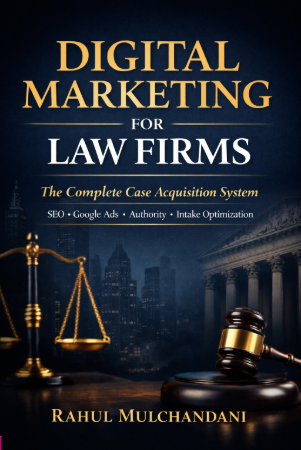
Author of "Digital Marketing For Lawyers" Book
Written by: Rahul Mulchandani
Founder, Digital Marketing Strategist and Author of "Digital Marketing For Lawyers" Book
Table of Contents
Personal injury PPC remains the fastest path to signed cases for most plaintiff firms. When executed with precision, it consistently outperforms SEO and referrals in the first 90 days while delivering measurable cost-per-signed-case data that contingency-fee practices can actually underwrite. In 2026, the difference between burning budget and building a predictable pipeline comes down to granular campaign architecture, case-type segmentation, ruthless negative keyword discipline, and conversion tracking that reaches all the way to retained clients—not just form fills.
This guide cuts through the generic PPC advice and gives managing partners and in-house marketers the exact framework used by firms generating 15–35 new cases per month from Google Ads alone. You will learn how to research keywords that actually convert, structure campaigns that Google rewards with lower CPCs, write ads that comply with state bar rules while still driving calls, build landing pages that turn 8–12% of clicks into qualified leads, and scale budgets without destroying profitability.
What Is Personal Injury PPC and Why Law Firms Need It
Personal injury PPC is paid search advertising—primarily Google Ads—targeted at searchers actively looking for legal representation after an accident, slip-and-fall, product defect, or medical error. Unlike brand or informational campaigns, every click is transactional: the user has an injury, a statute of limitations ticking, and a clear intent to hire.

For law firms this channel matters because personal injury cases are high-value and time-sensitive. A single car accident or trucking case can generate $15,000–$100,000+ in attorney fees, making even $500–$1,500 cost-per-lead economics viable when tracked to signed retainers.
SEO and content marketing build authority over 12–18 months; PPC delivers cases this quarter. In competitive metros, firms that ignore paid search simply lose market share to those who master it.
The 2026 reality is that Google’s algorithm now rewards advertisers who demonstrate strong user experience signals—low bounce rates, fast load times, and immediate value delivery—through Quality Score and ad rank. Personal injury campaigns that treat PPC as a “set it and forget it” line item bleed money. Those that treat it as a direct-response system with daily optimization generate predictable, scalable lead flow.
The Personal Injury PPC Landscape: Competition, Costs, and 2026 Benchmarks
Personal injury is among the most expensive verticals on Google Ads. In major markets, CPCs range from $70 to $250+ for core terms, with high-value keywords such as “truck accident lawyer” or “semi truck crash attorney” regularly exceeding $500–$1,000 in Los Angeles, New York, or Chicago. Cost per lead typically lands between $300 and $1,500, while cost per signed case sits between $685 and $1,466 depending on case type and market.
Conversion rates on optimized landing pages average 5–12% for clicks-to-leads and 3–8% leads-to-signed cases in most campaigns. Top-performing firms using exclusive, fast-response intake hit 20–30% lead-to-consultation and 40–60% consultation-to-retainer. These numbers are not theoretical—they come from aggregated 2024–2026 data across dozens of managed PI accounts.
The competitive edge comes from segmentation. Generic “personal injury lawyer” campaigns get destroyed by broad-match waste. Case-type segmentation (auto accidents, slip-and-fall, medical malpractice, premises liability) combined with radius targeting and device bid adjustments keeps Quality Scores in the 7–9 range and lowers effective CPC by 20–40%.
Keyword Research Strategies That Win Personal Injury Cases
Start every campaign inside Semrush Keyword Magic Tool. Enter seed terms such as “car accident lawyer [city]”, “slip and fall attorney near me”, or “truck accident lawyer”. Filter for commercial intent (keywords containing “hire”, “best”, “attorney near me”, “lawsuit”, “compensation”) and sort by CPC and volume. Export the full list, then use the “Refine Keywords” filter to strip out low-intent modifiers.
Cross-reference with SpyFu to see exactly which keywords your top competitors are bidding on and what their ad copy looks like. Google Keyword Planner gives volume estimates once you have an active Ads account, but Semrush and SpyFu reveal competitive density and historical trends that Planner hides.
Build three keyword buckets:
- High-intent exact/phrase match – “hire car accident lawyer [city]”, “[city] truck accident attorney”
- Question-based – “how much is my car accident case worth”, “what to do after slip and fall injury”
- Long-tail location modifiers – “personal injury lawyer [neighborhood] [city]”
Create exhaustive negative keyword lists from day one: settlement, jobs, salary, definition, pro bono, free advice, reddit, symptoms, lawyer salary, how long does it take. Update this list weekly using Search Terms reports. One firm I consulted reduced wasted spend by 34% in the first month simply by adding 87 negatives identified from actual search query data.
Get More Clients for Your Law Firm
Stop losing potential cases to competitors. Let’s build a strategy that brings you consistent, high-quality leads.
Structuring High-Performance Personal Injury Google Ads Campaigns
Never run one campaign for everything. Create separate campaigns for each major case type you accept: Car Accidents, Slip & Fall / Premises Liability, Medical Malpractice, Product Liability, Wrongful Death. Within each campaign, use single-keyword ad groups (SKAGs) or tightly themed groups of 3–5 closely related exact/phrase match keywords.
Set location targeting at the campaign level using radius bidding around your office or key hospitals. Enable call-only ads during intake hours and location extensions tied to your verified Google Business Profile. Use ad scheduling to run heavier during business hours when intake staff answer immediately—after-hours clicks convert at roughly half the rate.
Start with exact and phrase match only. Once you have 30–60 days of conversion data, layer in Smart Bidding and selective broad match with strong negatives. This structure gives Google clear relevance signals, improves Quality Score, and keeps average position 1–2 without overpaying.
Crafting Compliant, High-Converting Ad Copy for PI Leads
State bar rules prohibit guarantees, testimonials in certain formats, and misleading claims. California’s SB 37 (effective 2026) now requires every ad—including paid search—to disclose the city or county of at least one bona fide office location. Google’s lawyer verification process enforces this at the account level.
Effective headlines follow this formula:
[Injury Type] + [Location/Trigger] + [Benefit/CTA]
Examples:
- “Car Accident in [City]? Get Maximum Compensation – Free Consult”
- “Injured in Slip & Fall? Talk to [Firm Name] Today”
- “Truck Accident Lawyer [City] – No Fee Unless We Win”
Description lines must address pain points immediately (“Insurance company lowballing you?”) and include a clear call-to-action. Always add call extensions, location extensions, sitelinks to case-type landing pages, and structured snippets listing practice areas. Test three responsive search ads per ad group and let Google optimize. The highest-CTR ads routinely achieve 12–18% click-through rates when they match searcher pain and promise immediate next steps.
Landing Page Optimization That Turns Clicks into Consultations
Send every ad to a dedicated, case-type-specific landing page—never the homepage. The page must load under 2.5 seconds (Core Web Vitals compliant), feature a prominent above-the-fold intake form or “Call Now” button with click-to-call on mobile, and include trust signals: bar association badges, verifiable case results (with disclaimers), attorney bios, and client video testimonials.
Include a clear value proposition within the first five seconds: “No Recovery = No Fee • Free Case Evaluation • Same-Day Response.” Use exit-intent pop-ups offering an instant case value estimator or live chat. Heatmap tools such as Hotjar or Microsoft Clarity routinely show that forms placed above the fold convert 3–4× better than those buried below testimonials.
Mobile experience is non-negotiable—over 70% of personal injury searches occur on phones. Test pages on real devices weekly. Firms that achieve 10%+ conversion rates share one trait: they respond to every lead within five minutes, either by live call or automated text.
Bidding Strategies, Budgeting, and Smart Automation
Begin with Manual CPC or Enhanced CPC to gather data while maintaining control. Once you have 15–20 conversions per campaign, switch to Maximize Conversions or Target CPA. For higher-value cases (trucking, med mal), use Maximize Conversion Value with a target ROAS once offline signed-case data is imported.
Realistic monthly budgets in competitive markets start at $10,000–$25,000 per case-type campaign. Anything less produces too few clicks for statistical significance. Set daily budgets at 120% of target to allow Google’s algorithm room to optimize, then use shared budgets across case-type campaigns only after you have 60 days of data.
Conversion Tracking, ROI Measurement, and Scaling
Install Google Tag Manager and track every micro-conversion: form submit, call click, chat start. Use CallRail or WhatConverts for phone tracking with dynamic number insertion. The real ROI metric is cost per signed case, not cost per lead. Upload offline conversions (signed retainers) back into Google Ads using GCLID and the offline conversion import tool. This lets Smart Bidding optimize toward actual revenue, not vanity form fills.
Track lead-to-case rate weekly. Industry averages sit at 3–8%; top firms hit 15–25% with dedicated intake teams and CRM automation. When cost per signed case drops below 20% of expected case value, scale budget 20–30% monthly.
Common Personal Injury PPC Mistakes and How to Avoid Them
The most expensive mistake is sending traffic to the homepage. Distractions kill conversions. Second is broad match without negatives—many firms waste 30–50% of spend on irrelevant queries. Third is ignoring compliance: one bar complaint or Google policy violation can pause the entire account.
Fix these by using dedicated landing pages, building negative lists from Search Terms reports every Monday, and reviewing every ad against your state bar advertising rules before launch. Also, skip remarketing audiences based on injury-related pages—Google prohibits ads based on personal hardships.
Next steps: Open Google Ads today and audit your current account against the campaign structure outlined above. If you don’t have one, create separate campaigns by case type using exact match only and the negative keyword list from this guide. Set up conversion tracking with offline import capability before spending another dollar. Run a $2,000–$3,000 test budget for 30 days on your highest-value case type, measure cost per signed case, then decide whether to scale or refine. Firms that follow this exact sequence see profitable lead flow within the first 45–60 days.
Frequently Asked Questions
What is the average cost per click for personal injury PPC in 2026?
Average CPC for personal injury keywords ranges from $70 to $250 in most markets, with high-value terms like “truck accident lawyer” often exceeding $500–$1,000 in competitive cities. Actual costs depend heavily on Quality Score, location, and competition. Maintaining a 7+ Quality Score can reduce your CPC by 20–40%. Plan budgets backward from your target cost per signed case rather than chasing the cheapest clicks.
How do I research effective keywords for personal injury PPC?
Use Semrush Keyword Magic Tool with seed terms like “car accident lawyer [city]” and filter for commercial intent. Cross-reference with SpyFu for competitor data and Google Keyword Planner for volume. Create buckets for exact high-intent, question-based, and long-tail keywords. Build and update a negative keyword list weekly from Search Terms reports to eliminate waste.
What is the best campaign structure for personal injury Google Ads?
Run separate campaigns for each case type (Car Accidents, Slip & Fall, Medical Malpractice, etc.). Use tightly themed ad groups with exact and phrase match. Target by radius, enable call and location extensions, and align ad scheduling with intake hours. Start manual and move to Smart Bidding after gathering conversion data.
How do I write compliant and high-converting personal injury ad copy?
Follow state bar rules—no guarantees. Use headlines like “[Injury Type] in [City]? Free Consultation – No Fee Unless We Win.” Address pain points in descriptions and include strong CTAs. Add extensions for calls, locations, and sitelinks. Test responsive search ads and aim for 12–18% CTR while keeping all copy compliant.
What makes a personal injury landing page convert well?
Use dedicated case-type pages that load under 2.5 seconds. Place intake forms or click-to-call buttons above the fold with clear value propositions and trust signals (bar badges, results, bios). Optimize for mobile and respond to leads within five minutes. Purpose-built pages routinely achieve 8–12% conversion rates.
Which bidding strategy works best for personal injury PPC?
Start with Manual CPC or Enhanced CPC. After 15–20 conversions, switch to Maximize Conversions or Target CPA. For valuable cases, use Maximize Conversion Value with target ROAS once offline signed-case data is imported. Smart Bidding performs best with accurate full-funnel tracking.
How much budget should a law firm allocate to personal injury PPC?
In competitive markets, budget $10,000–$25,000 monthly per case-type campaign. Lower amounts limit data for optimization. Set daily budgets 120% of target. Scale only when cost per signed case remains below 20% of average case value.
How do I track ROI accurately in personal injury PPC?
Track form submits, calls, and chats via Google Tag Manager. Use CallRail or WhatConverts for phone calls. Import signed retainers as offline conversions using GCLID. Focus on cost per signed case and lead-to-case rate rather than cost per lead.
How quickly should my firm respond to PPC leads?
Respond within five minutes for best results. Leads answered under five minutes convert at 20–30% to consultations versus much lower rates for slower responses. Use automated texts and have clear after-hours routing. Fast response is often the biggest factor in lead quality.
Can I use remarketing for personal injury PPC?
No. Google prohibits remarketing based on sensitive categories like personal injuries. Focus budget on fresh search traffic and strong first-click experiences instead of retargeting past visitors.
Should I run Google Local Services Ads with personal injury PPC?
Yes. LSAs appear above regular ads, charge per lead, and carry Google’s verification badge. Many firms run them alongside search campaigns—LSAs for volume and PPC for control and branding. Keep both active for best coverage.
What trends should I watch in personal injury PPC for 2026?
Smart Bidding and Performance Max continue to improve with better offline data. Expect stricter compliance on disclosures and more emphasis on user experience signals. Case-type segmentation, fast response systems, and dedicated landing pages remain the core drivers of profitable campaigns.
🚀 Get Free Consultation
Our Latest Posts
-
 How We Generate Signed Cases for Lawyers: 7 Proven Strategies That Deliver Real Results
 -
 Case Study: Multi-City Personal Injury SEO Success – New Mexico
 -
 Case Study: Personal Injury Lawyer in Texas
 -
 Lawyer SEO: The Complete Guide to Optimizing Law Firm Websites for Clients and Rankings
 -
 Why Lawyer Switch to Us
Updated on
Get In Touch with Us!
other way to contact us
Office Email
rahul@webkeydigital.com
Office Phone
+1 503-303-8639
Office Location
8 The Green STE A, Dover, Kent , Delaware 19901
